Much of Aldo Chaparro's work is based on quick processes, which forces him to have a close relationship with his materials. The canvas, custom made for him, is 1.81 x 1.81 meters, exactly Aldo's height. For him the most important part of the art is the performance, the action and moment when creating the piece, what is left is only the document.Inside his bedroom he played with the sunlight entering the terrace at a specific time, so only for a few minutes on a concrete day of the year will his piece be completely aligned.The title of each piece he did while in his residency is the time and date when he created each one, remarking that the action is more important than the final result.
The canvas, custom made for him, is 1.81 x 1.81 meters, exactly Aldo's height. For him the most important part of the art is the performance, the action and moment when creating the piece, what is left is only the document.Inside his bedroom he played with the sunlight entering the terrace at a specific time, so only for a few minutes on a concrete day of the year will his piece be completely aligned.The title of each piece he did while in his residency is the time and date when he created each one, remarking that the action is more important than the final result.
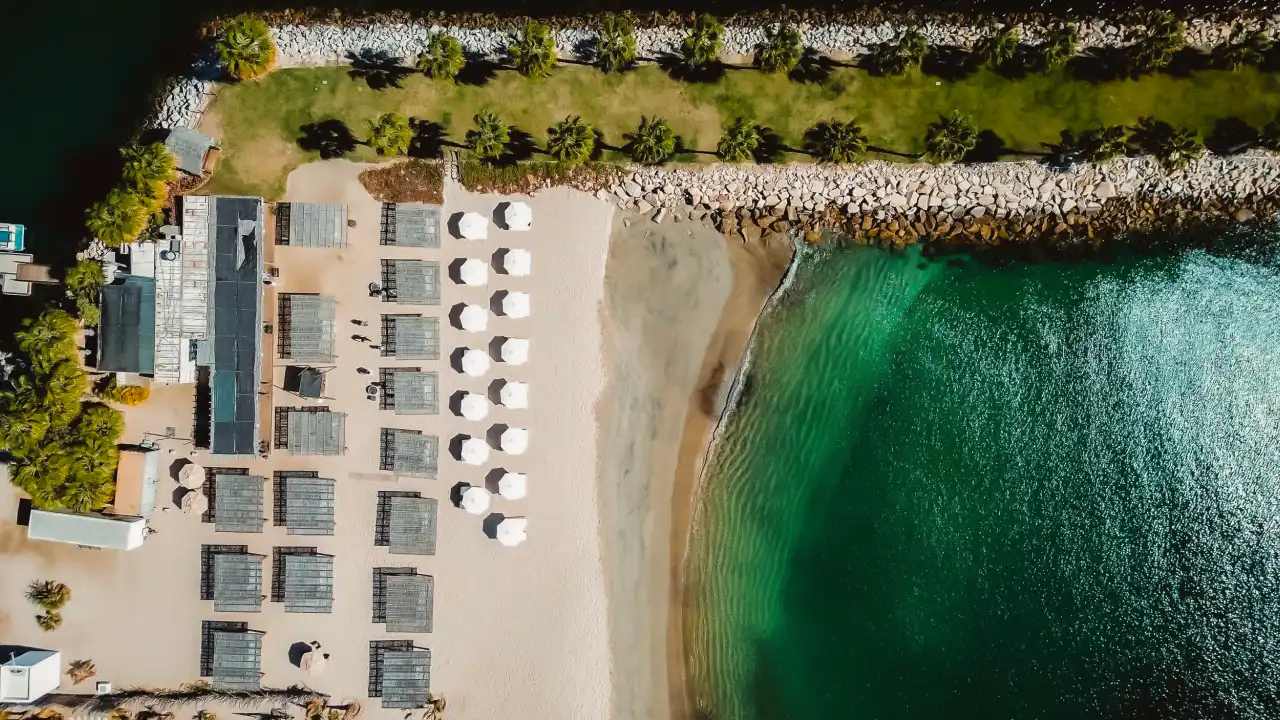
In projects like these, I try to do a mix. I plan only the half of the project and I let the rest of the project to be driven by what's happening. To feel the space, to be there, to connect with a space, with a room, with a beach. It's an opportunity for an artist to create a piece from nothing, only from your experience in the space. I spent two weeks or more than two weeks. I had enough time to think about the light in the room, things that I found on the beach. I tried to connect everything. The main piece in the room, I don't know if you saw it. In the terrace, I discovered that at 2:30, 2:20 in the afternoon, the light, the sun makes a line on the wall. I discovered that perfect moment in the day when the line of light and shadow was exactly from one corner of the wall to the other corner. And I mark at 2:20 and I marked the light area and I covered it with gold leaf. And at the perfect moment, the light hits the foil that I marked. And I started to think about the light and collect these objects in the beach. And at 2:20. I took a photo of the objects how I found them and how the light hits them. And then tried to reproduce that light when the sun hits the objects at that time, so I only covered those areas with the gold leaf. And that was the idea, to try to preserve that moment of light. The other two pieces were the stain on the wall. It is a piece that I made on many occasions, and the other is that Canvas in the room where the action happens inside the canvas and outs. Those two pieces are connected. Because for me it's very important. I always say that it's like a triangle, the idea, you have one idea and then you have to decide the material and when you decide the material and you have to decide the time. The time that you're going to spend on the work. It is very close relation because if you do have an idea in vidrio, you can't do it in marble, if you have an idea in wood, you can't do it in steel. It is a strong relation. When do you decide this relation you have to decide the time. If you want a piece that is going to work in three months and you give to the piece three months and one week, the piece has failed. The relation is super strict because I love fast process because when you work fast, you have to be in the present because you need all your attention. This is more physical but when you work long periods of time, it's more like your mind is everywhere and your ability, carving, is a mechanical action but your mind is in another place. In fast process you have to live in the present. The moment when the sun hits the object, paint stain in the wall it takes me like one second to create the piece. But the important part for me is, with my work, I have the opportunity to live in the present. During the day, my mind is everywhere, my body is doing something mechanical. I work in the computer. But my work gives me the opportunity to live in the moment, to be present. That's why the title of many of my pieces is the hour, the day, the month and the year when I made the piece. It happens with the pieces in the hotel too. The two pieces the process happened fast, super fast and the others were about the light, the moment of the light.

Yeah, it's like constantly being in transition because there are different people and after you there's going to be another person coming. It's not like a museum where you hand the piece and you know that the situation is not going to change so much but it's a personal space where the situation is going to change and the way the piece is going to be experienced is going to change. I love hotels because for me this is a super interesting space because of the way you live in a hotel. It's like you're in a house but in different country and different language, different place and you have to adapt your structure to the way that hotel works. With those pieces, I was trying to think about the next guest and what he is going to think about my work. I think if we put like a sculpture or a painting on the wall that can’t create the connection because it is not a museum, it is not a house. A painting on the wall or putting a sculpture in the base will act as a decoration but I want to create something more dynamic to make the guest think and experience. One of the pieces on the shelf is a wing of a dead bird. I don't think in any of the hotels you can see the wing of a dead bird and I covered it with gold and now he's part of the of the room. Most of the pieces on that shelf are garbage but now they are part of the decoration of the room.
What I had mentioned to you a moment ago is that in my experience these kind of projects never work because they don't have enough base in reality. In the Ganzo, everything works because there it doesn't feel like a museum or a gallery. You are going to spend two weeks, make some piece that you'd like inside your room or feel free to do whatever. That's super important because it is relaxed, they understand that in one week or two weeks it is impossible to make like a marble giant sculpture and that makes things possible. Okay you have a pen, Pedro Reyes has charcoal and he makes drawings in the room. It is easy, it is fresh, it is fun. Going to the beach you are happy and you try to combine relaxation and creation. It is perfect because here in the city, I have a lot of work and it's super boring work because it is institutional, clients, computer but by the sea my mood is different, I am happy and relaxed and I have this room to do whatever I want. I think that's the key of how this project in the Ganzo is reality.
It was super fun, super fun. I love to work with kids and we made like three or four sculptures. It was incredible. I wanted to do the same that I did in the room. What I told them was to find things around that you like and you think that you can do something with those objects and they decided to choose the more predictable ones like a piece of wood. I said no, no, no, just garbage, like flowers, plants, it not necessary for the piece to live forever. Use clothes and toilet paper, and they started thinking like it is a construction for a moment and not a sculpture. That gave them the freedom to collect and work. We worked together for 4 hours or so.